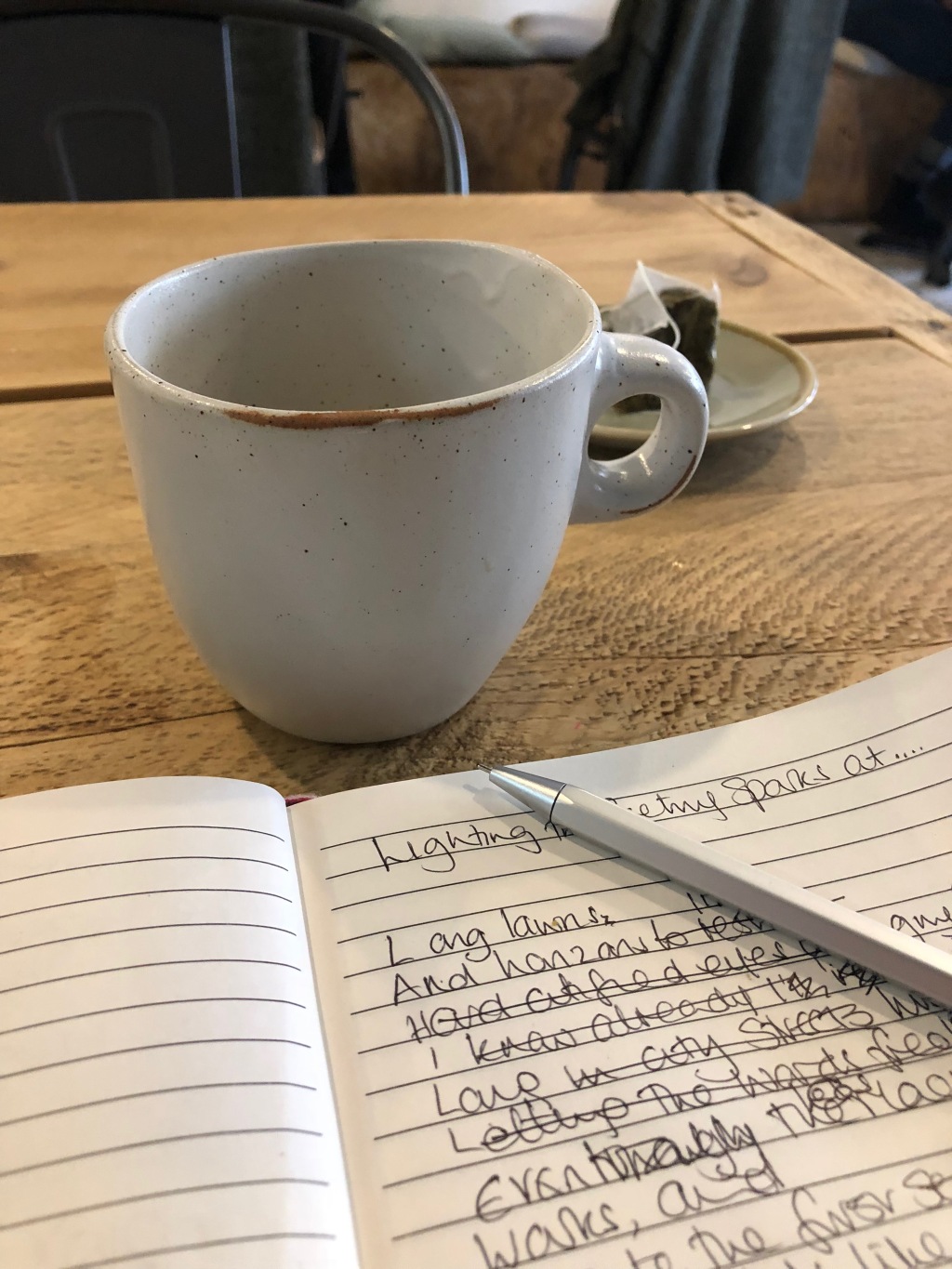
Chelsea Fringe – London Garden No 3

Five Minutes Peace: a garden to sit in, a poem to read, and a prompt to write to … No 3. (Find out more about what this is all about here.)

GEFFRYE MUSEUM, HOXTON

L1070417

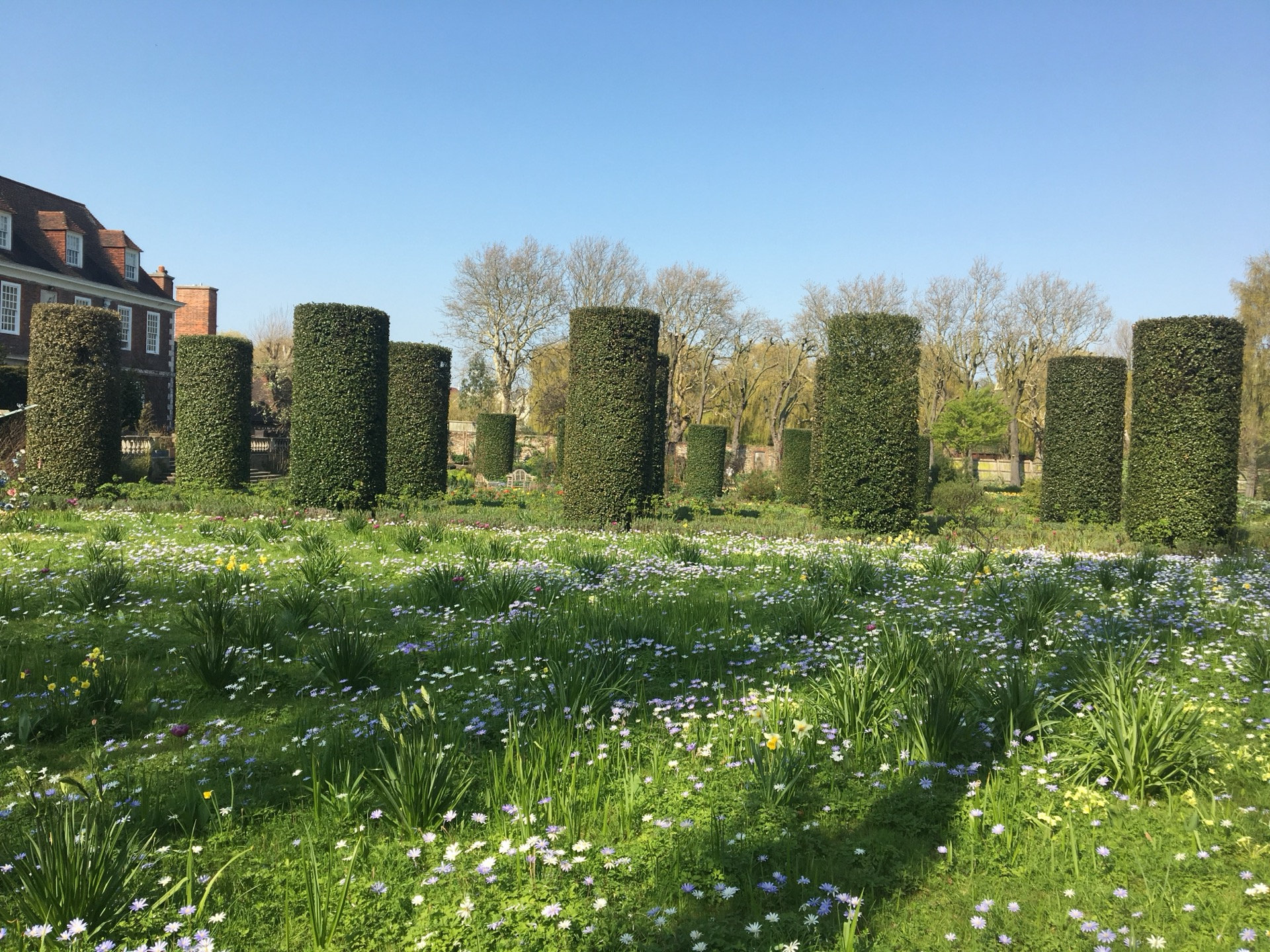
When I first arrived at the Geffrye Museum, I thought that the ‘garden’ was the stretch of grass at the front. Nice, I thought, but not that inspiring. And then I walked round the back.

L1070453

This is a museum of the home, situated a bit poignantly in former Almshouses, and just as the rooms inside take you from century to century, so there are a series of historically researched garden rooms outside. It was fascinating to wander through from the 16th century to the 18th century via the 17th century and back again.

L1070456

But never dry. All the senses are engaged such as when you walk past a bed dripping with hyacinths…

L1070486

And can’t quite resist touching the coloured knot garden to see if the textures are as subtle… Or you would, of course, if you weren’t as well behaved as me…

L1070502

It’s a constant feeling of exploration and yet a sanctuary too.

L1070504

Given the weather, it was also lovely to see the indoor garden reading room. I could have stayed in this spot for weeks.

L1070547

Another garden magazine? Or a book on historic interiors? Yes please…

L1070550

In fact, the whole garden is so peaceful that’s it is hard not to imagine you are well away in the country..

L1070511

Until a train comes by to remind you of just where you are!

L1070432

As well as the museum, there are two almshouse rooms furnished as they would have been for residents. These  are open at certain times of the day, and well worth a visit. I couldn’t help thinking of a governess like Jane Eyre living here, if she hadn’t of course married Rochester. A comfortable attic at least…

L1070639

So here’s Lisa Creagh, an artist who has a show at the Little Black Gallery for the Chelsea Fringe, reading an extract from Jane Eyre. That’s Lily, her baby, you can hear in the background… because she’s named after a flower, it seemed appropriate to keep her in!

And below is the view from ‘Jane’s’ room. Your creative writing prompt for today is to write about a garden seen from a window…  here’s a poem by Emily Dickinson for inspiration.

Tree in Winter

Emily Dickinson

Not at Home to Callers

Says the Naked Tree –

Bonnet due in April –

Wishing you Good Day -

L1070638

Please note, Lisa and I will be in conversation about flowers, gardens, art, writing and creativity at the Little Black Gallery on Friday 24th May. Places are free but limited so do nab one if you are interested in coming by emailing info@thelittleblackgallery.com.  We hope to see you there! More details here.

Chelsea Fringe – London Garden No 2

Five Minutes Peace: a garden to sit in, a poem to read, and a prompt to write to … No 2. (Find out more about what this is all about here.)

L1070231

You may have passed this garden several times already. And perhaps like me, you’ve never noticed it, let alone ventured inside … but St Anne’s Churchyard in Wardour Street is a gem of a green public space, right in the middle of the city.

annesbenches

Perhaps given the location, it’s not surprising it has a rich literary heritage as the burial ground of the essayist William Hazlitt

annes hazlitte2

And I was also excited to see the memorial plaque for David Williams, founder of the Royal Literary Fund (my lovely employers as an RLF Fellow at the LSE for three years).

anne - rlf

Dorothy L Sayers was even Churchwarden at St Anne’s Church from 1952 to 1987. I like to imagine her writing in the churchyard sometimes.

The churchyard however has been a public garden since 1892, and to get to St Anne’s Church you have to go round the corner to Dean Street. Please do, though, if only to see the passersby wonder where you’re off to as you head off down the little passage to get there!

annesview

The original Wren Church was destroyed in the war, but there’s a separate Church garden you can see from the Churchyard. I loved these stones in particular.

annes stones

They are embedded in the walls of a secluded circular amphitheatre as if the people themselves are still present:

annes church 2

BUT… back to the Churchyard. I sat there and thumbed through some of Hazlitt’s essays I’d taken with me. He is a beautiful writer, so I was finding myself underlining sentences and then mumbling them out loud just for the joy of hearing the words in my mouth:

If from the top of a long cold barren hill I hear the distant whistle of a thrush which seems to come up from some warm woody shelter beyond the edge of the hill, this sound coming faint over the rocks with a mingled feeling of strangeness and joy, the idea of the place about me, and the imaginary one beyond will all be combined together in such a manner in my mind as to become inseparable.

And here’s an extract from On Poetry:

Let the naturalist, if he will, catch the glow-worm, carry it home with him in a box, and find it next morning nothing but a little grey worm; let the poet or the lover of poetry visit it at evening, when beneath the scented hawthorn and the crescent moon it has built itself a palace of emerald light.

Oh yes.

anne hazl

One of the nicest things about the Churchyard, in my opinion, is that as well as the individual benches, there are seats waiting to be filled with friends, hospitality and you imagine, lots of laughter.

anne triangle

And how about a writing group here?

anne table

So… if you would like to write in St Anne’s Churchyard, or anywhere else for that matter, and Hazlitt’s invitation to visit the glow-worm’s emerald palace in the evening isn’t enough, I offer this prompt today. To write about an ideal picnic. Maybe it’s one you’ve been on already, or have planned, or maybe – given the rain – you’ll take your inspiration from one of my favourite watery  picnics, from Kenneth Graham’s Wind in the Willows, of course:

The two animals made friends at once. Ratty was very surprised to hear that Mole had never been in a boat before.

“There is nothing half so much worth doing,” he told Mole, “as simply messing about in boats.”

Then he had an idea. “Look here, if you’ve really nothing else to do this morning, why don’t we go down the river together and make a long day of it?”

“Let’s start at once!” said Mole, settling back happily into the soft cushions.

The rat fetched a wicker picnic basket. “Shove that under your feet!”

“What’s inside?”

“There’s cold chicken inside,” said Rat, “cold-tongue-cold-ham-cold-beef-pickled-onions-salad-french-bread-cress-and-widge-spotted-meat-ginger-beer-lemonade — “

“Oh stop!” cried Mole in ecstasy. “This is too much!”

“Do you think so?” said Rat, seriously. “It’s only what I always take on these little outings.”

Chelsea Fringe – London Garden No. 0.5

Five Minutes Peace: a garden to sit in, a poem to read, and a prompt to write to … No 1. 

I know I don’t officially start until tomorrow, but I CAN’T WAIT!

chelsea fringe logoSo I’m also cheating because here is a garden that isn’t really a garden…

IMG_5191

Confused?

I hope so. About two weeks ago, I went on a walk round my own homeground, Fitzrovia, with the Old Map Man (aka Ken Titmuss). The idea of these walks is that you mooch around an area of modern London using 17th and 18th century maps to guide you. It’s a fascinating way to see the different layers to a place you think you know well.

IMG_5162

One of Ken’s maps from the mid-17th century showed how most of Fitzrovia was little more than fields and farms bordered by Tottenham Court Road and Oxford Street. Food and vegetables came into the centre from a road named ‘The Green Lane’. Here it is a little closer.

IMG_5153

And the bones of that road still remain, albeit joined now by hundreds of others. It’s not called The Green Lane anymore because… surprise surprise, it’s Cleveland Street. To be honest, there aren’t many places there to write or read in peace but it’s still a street that’s not short of literary inspiration because the Cleveland Street Workhouse (facing a current demolition dispute) was apparently the inspiration behind Charles DickensOliver Twist, and the author lived just a little further up the street.

IMG_5193

A nice distraction but I was on the look out for garden and nature inspiration, so it was particularly pleasing to find, just 100 metres off Cleveland Street in Riding House Street, this pub.

green man

I really hope it got its name because of its proximity to the original London Green Lane.

green man

But in any case, it is a brilliant excuse to share one of my favourite poems:

Green Man in the Garden

Charles Causley

Green man in the garden

Staring from the tree,

Why do you look so long and hard

Through the pane at me?

Your eyes are dark as holly,

Of sycamore your horns,

Your bones are made of elder branch,

Your teeth are made of thorns.

Your hat is made of ivy leaf,

Of bark your dancing shoes,

And evergreen and green and green

Your jacket and shirt and trews.

Leave your house and leave your land

And throw away the key,

And never look behind, he creaked,

And come and live with me.

I bolted up the window,

I bolted up the door,

I drew up the blind that I should find

The green man never more.

But as I softly turned the stair

As I went up to bed,

I saw the Green man standing there.

Sleep well, my friend, he said.

Hmm, that never fails to make me shiver at the end.

And now I invite you to write something yourself…

Describe the colours in your garden, or where you might be sitting, through another sense. So the red of the rose might be the heat of fire on your skin, the blue of the bluebell in the woods could remind you of the sound of cymbals in a school orchestra, the white of the magnolia is the taste of ice cream…

rain

Here’s a poem I remember learning at school that worked along these lines…

I Asked The Little Boy Who Cannot See

Anon

I asked the boy who cannot see,

‘And what is colour like?’

‘Why, green,’ said he,

‘Is like the rustle when the wind blows through

The forest; running water, that is blue;

And red is like a trumpet sound; and pink

Is like the smell of roses; and I think

That purple must be like a thunderstorm;

And yellow is like something soft and warm;

And white is a pleasant stillness when you lie

And dream.’


Please feel free to share what you write in the comments sections, or on your own website. And, from tomorrow, you can follow more gardens on the Chelsea Fringe page on this website. Do sign up in the box on the right if you would like this website to appear in your inbox.

The Botanical Park and Garden of Crete

On the plane back from Crete yesterday I noticed that the woman behind me kept her hand on the window until we had been in the air some time. I wondered if she was feeling the same pangs of loss as I was for all those endless horizons and quiet feelings of space.

L1080073

So although my head is already full of London gardens as I prepare my posts for the Chelsea Fringe

crete10

… I can’t resist a little diversion to remind me of a blissful – less busy – day last week at the Botanical Park and Garden of Crete.

L1080054

The Park has literally risen from the ashes of a family olive farm on hillside near Chania in Western Crete. On the website, they say:

By the end of October 2004, a sudden hot wind storm from Africa caused an electricity pole wire to break. This started a wild fire, which very quickly spread around so much that no one could control it. Twenty-four hours later, the whole region around the village had burnt almost to the ground.

The damage was unprecedented: sixty thousand olive trees over 400 hundred years old had been burnt. My village had been ruined both financially and ecologically.

L1080002

But even from this tragedy something good happened, because what the family have created from the ruins is very special. Winding paths take you around a walking lesson in the world’s botany, from fruit trees to herbs to flowers to vines. All carefully chosen, tended and usefully labelled.

L1080071

And if the signs can sometimes be charmingly ‘teacherly’…

crete5

They also introduced us to plants we’d never heard of before, and yet feel all the better for knowing now.

L1080034

crete2

But most of all it really is proof that nature is indeed the best health cure …

L1080015

… for the heart and the eye as well as the body…

L1080026

crete1

L1070997L1080016

crete7

And so, in honour of its history, here’s Réne Stefanelli’s poem – THE OLIVE TREE. Please click and read – It could almost have been written for the Park.

crete3

You can find out more about the Park at its website, and if you are in Crete, I really recommend a visit. And if you do got there, make sure you leave time to fit in a lunch at their restaurant. All the dishes are locally sourced, with herbs and fruits from the garden itself. I had chicken with oranges and lemons – so delicious I was tempted later to sneak in an extra taste!

L1080045

Reading and Writing … at the Chelsea Fringe

WRITERINTHEGARDENI’m delighted to be – virtually – taking part in the exciting Chelsea Fringe Festival this year.

I’ll be posting from a selection of London gardens and parks – some well-known, some you may have overlooked – with photographs, a little bit of gossip, and for each one, I want to offer you a poem to read which has been chosen specially to add another layer to the experience of the park.

There will also be a series of creative writing prompts to encourage you to write in a garden – wherever you are! I would love for you to join me.

My Chelsea Fringe ‘virtual tour’ starts on 18th May. See you then!

Villa Gamberaia, Florence

Although Villa Gamberaia is outside Florence (a 30 minute No 10 bus ride from San Marco Square), it has been designed so the view of the city becomes part of the garden itself.

ga12

It’s a garden that has been much written about, ‘Nowhere else in my recollection have the liquid and solid been blended with such refinement on a scale that is human yet grand without pomposity..’ wrote Harold Acton. ‘It leaves an enduring impression of serenity, dignity and blithe repose.’

gamb2

Certainly, the water parterres help with this feeling of serenity. It’s hard to imagine now the shock the replacement of formal flower beds with water must have caused when Princess Ghika transformed the gardens at the beginning of the twentieth century. According to Monty Don in his Italian Gardens programme (a clip is given below), Princess Ghika was a Rumanian Princess who went out heavily veiled after she had lost her famous beauty, and would swim in these pools. I hope that she took off her veils in the gardens at least so she could see the beauty she had created.

gamb

The photograph above was taken from the terrace – it’s a garden to be admired from all angles and at every window from the house, which has a beautiful inner courtyard as well.

g13

And it was seeing this courtyard that made me realise that, despite the view, all the statues looked inwards as well. Almost as if they were giving permission to forget the outside world and take sanctuary in the garden.

g35

And despite its relatively small size, the garden contains contrasts and surprises. The intimate rockwork garden for instance, which led from the bowling green:

g40

And then there’s the Nymphaeum:

g56

And gates everywhere, taking you through to explore another sense – another atmosphere.

gaxx

Again, as with the other Florence gardens, we went at the wrong time for flowers but I imagine that the box topiary shapes would dominate anyway. The shapes again suggest floating, or clouds.

g37

g30

But, do you know what, this is a garden that encourages silence, introspection and bliss. I can’t imagine visiting here and walking round carrying on a day-to-day chat, so I’ll shut up now and let you enjoy it for yourselves.

ganb3g55

g14g16g25g18g5g22g7g11

g10

ga60g44

ga40ga50ga7

ga8

The amazing thing is that, although it is privately owned, you can actually rent out the villa and stay there.

g8

Imagine writing in this room… what did Cicero say? ‘”If you have a garden and a library, you have everything you need.”

ga16
Or here..

ga21

But I had to take my notebook home to write – this time at least! I took the shape of the garden for my piece, and took courage in the fact that a garden, even one as fine as Gamberaia, is too a work in progress!


Forget love; it’s stories of lost beauty that capture me now. For a Rumanian princess to veil herself through shame at the lines life had left, for her to swim only at midnight when all the garden visitors have left. Did she keep her eyes shut even then in case she caught sight of her reflection, or did she float looking out at the view through a net film?


Found in the forest car park

a top-shelf magazine, girlie

and me, tramping it into the puddle

but the photograph won’t stop smiling

back at my brothers, their laughter.


Stop a minute.

Get out of your brain.

Think with your feet,

arms, belly.

Move, feel, taste life.


‘Smell this,’

he’d hold the earth

right up to our faces,

‘that’s the fens that is’.

At night before sleep,

I’d take his hands,

pretend to plant

potatoes in the creases.


Money doesn’t grow on trees

but my father had a trick

whereby he’d twist our heads

this way and that,

pull coins from our ears.


Imagine

a world

seen only

through

lace holes.

Did

the French

nuns,

who made it

imagine

a bride,

love, happiness,

children;

their fingers

dancing over

silk threads?

And here’s Monty Don’s piece on the garden which gives more of the history:

ga2 ga4 ga5 ga6 ga7 ga8 ga9 ga12 ga15 ga16 ga21 ga30 ga40 ga50 ga60 ga60

Boboli Gardens, Florence

Our second Florence garden was the Boboli Gardens, just behind the Pitti Palace. Originally built for the Medici Family, and constructed on a hill once covered with olive trees and vineyards, it still retains an air of a perfect Italian classic design although apparently…

‘During the brief period of French rule, the Boboli gardens ran the risk of being turned into an English Park.’

L1060549

Phew.

But if it was saved from nasty English influence, records show that in 1932, the majestic amphitheatre was the scene of flag throwing performance of Hitler and Mussolini before being turned into a vegetable garden. Hard to imagine now.

L1060482

Although records are sketchy, or those that I can find anyway, it does feel that the extension to the Palace and the gardens were done at the same time. There’s a pleasing organic feel to them, and also, given the scale of these gardens, a surprising sense of personality coming through.

L1060552

L1060556

L1060484

Today we miss the ‘thrushery’, a hunting ground for the Medici but what for? Thrushes? And talking of birds, there was once apparently a magnificent aviary near the Kaffehaus, as well as an exotic menagerie. The Garden of Madama, a market garden of citrus trees and flowers commissioned by Giovanna of Austria, the wife of Francesco 1, has gone but her grottinca still remains, begun in 1553, it was one of the first of its kind.

madama

Still very much present is the famous ‘fountain of Bacchus.’ I’d read that this was a portrait of Cosima’s household dwarf, but when I investigated, this is apparently untrue as Cosima was too fond to have him ridiculed like this, but even so. (The turtle is a Medici symbol.)

L1060487

But practical jokes were welcome elsewhere. Like many gardens of their time, especially one built round water like Boboli, there was much play with watertricks. One jet at the Isolotto could shoot upwards to a height of 71 feet, 8 inches. Mind you, on this rainy day in Florence, it felt as if the water was coming down, not up..!

IMG_4865

But it’s the Grotto of Buontalenti which is really special. Open only at certain times during the day, it once featured four sculptures of slaves by Michelangelo, which have since been replaced by plaster of paris copies, but you can still imagine what it must have been like.

IMG_4846

boboligrotto

I would have loved to have seen it in its heyday, when hidden water jets drenched unwary visitors, and a central jet could be adjusted to reach the ceiling. The statue of Venus in the third chamber, by Giambologna, has its own secret story. Although the artist begged in vain to be allowed to work on it further, Duke Francesco was so pleased with it that he apparently kept it in his personal chamber for a while before moving it to the Grotto.

L1060504

When the grotto was originally built, Buontalenti suspended a crystal fish basin from the vault’s skylight, but it proved too difficult to keep the fish alive due to the temperature changes. However, it’s wonderful to think what  the lights and reflective splashes from the basin would have added – a real feeling of being underwater.

fishbowl

This is the poem I wrote in the gardens:

Wanting to see everything, we queue

to visit the grotto, have our pictures

taken by a naked dwarf riding a tortoise,

imagine the wild animals, wild

parties, but the real fantasy would be living

in a world when you would hire Michelangelo

to sculpt mighty slaves emerging

from the underworld, and yet

you’d still feel safe, on top.


Here’s a piece by Monty Don from his television series on Italian Gardens which interestingly shows the contrast between Boboli and Villa di Castello: